Hippocratic Oath: Traditional
The newly graduated, Hippocratic physician, swore to the Hippocratic Oath, to uphold an professional ethical standard, to be bound to the gods and the people who paved the way for them; honoring the gods and treating there teachers as if they were family. | 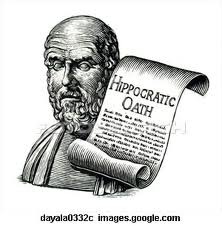 |
The physician agreed to treat patients to the best of their
knowledge and ability; swearing not to bring their patients harm. Patients were
not to be given poisonous drug or be cut open by someone who had no skills with
a knife. They pledged not to get into promiscuous situations with patients, or the
patients acquaintances while in presence of their home, during their care. Nor were they to speak of the patients private
matters others.
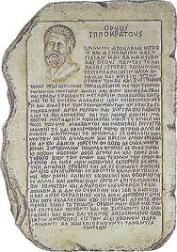 | So long, the newly appointed physician followed this pact, respect,
health, and prosperity would fall upon them. If the pact was broken, shame,
disrespect, and sickness, would surely be coming their way. |
The Oath of Hippocrates
I swear by Apollo the physician, and Asclepius, and Hygieia and Panacea and all the gods and goddesses as my witnesses, that, according to my ability and judgement, I will keep this Oath and this contract:
To hold him who taught me this art equally dear to me as my parents, to be a partner in life with him, and to fulfill his needs when required; to look upon his offspring as equals to my own siblings, and to teach them this art, if they shall wish to learn it, without fee or contract; and that by the set rules, lectures, and every other mode of instruction, I will impart a knowledge of the art to my own sons, and those of my teachers, and to students bound by this contract and having sworn this Oath to the law of medicine, but to no others.
I will use those dietary regimens which will benefit my patients according to my greatest ability and judgement, and I will do no harm or injustice to them.
I will not give a lethal drug to anyone if I am asked, nor will I advise such a plan; and similarly I will not give a woman a pessary to cause an abortion.
In purity and according to divine law will I carry out my life and my art.
I will not use the knife, even upon those suffering from stones, but I will leave this to those who are trained in this craft.
Into whatever homes I go, I will enter them for the benefit of the sick, avoiding any voluntary act of impropriety or corruption, including the seduction of women or men, whether they are free men or slaves.
Whatever I see or hear in the lives of my patients, whether in connection with my professional practice or not, which ought not to be spoken of outside, I will keep secret, as considering all such things to be private.
So long as I maintain this Oath faithfully and without corruption, may it be granted to me to partake of life fully and the practice of my art, gaining the respect of all men for all time. However, should I transgress this Oath and violate it, may the opposite be my fate.
Translated by Michael North, National Library of Medicine, 2002. ("Greek Medicine" February 07,2012) |
Hippocrates, put this oath together, so that the physicians
had to take responsibility for their actions. The physician was a person of great honor and power. They had
power to give life or take life at their discrepancy. | 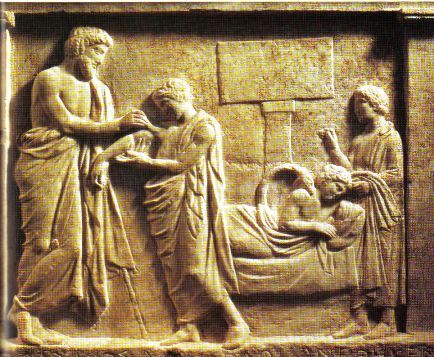 |
The Hippocratic Oath was dedicated to give the physician, a code of conduct, and set forth as an example of what Hippocrates expected his pupils to be, for not only did they represent themselves, to be a respectable healer, they also represented himself, as well as the, School of Hippocratic Medicine, and all physician alike. But also, the Hippocratic Oath, provided a safety net for the patients, to keep malpractice from happening.
If the physician wanted too, they could wreak havoc in a patient’s life. For example,
a far stretched condition would be, one could
con a patient into
taking medicines that was
suppose to help them with their illness, but
instead, after the patient payed for the medicine
and treatment, finds out that the
physician
poisoned them on purposely to take them out
of the picture so that
the physician could marry
the patient’s wife.
It was Hippocrates intent, when writing the oath, to keep the profession pure according to the divine laws, through the life and practice, of the respected physician. In time the Hippocratic Oath, was used by many western medical physicians who followed Hippocratic path. But during the journey of time, the oath was changed in relationship with new medical technologies and society rules. The question is now, does the new oath of today provide the same effect of purpose, providing a code of conduct, as well as, protecting the patient.
